




living matter transforms energetically into organic matter, which in turn is necessary to produce living matter once again. It really is a beautiful process, and to me is the most concrete example of reincarnation. I will never look at moldy, rotting things the same. And so I see ants as the foot soldiers of the perpetuation of life.
I
was a huge fan of Dr. Seuss when I was a little girl. I was
fascinated by the buildings in the pictures, and their dimensions
always sent my imagination soaring. What a world! All those crazy
stairs that led to nowhere, or maybe somewhere I couldn't
see...pure magic! M. C. Escher's work appeals to me for the
same reasons as an adult. But there's more complexity to his
concepts. This artist is unique in that he combines art and
science; aesthetics and physics. He's like a theoretical physicist
who draws instead of writing equations or conducting experiments.
Looking through Escher's work is like an adventure for the mind,
and holds me spellbound in the same way Gleick's book on Chaos
theory or Kaku's book on hyperspace did. My favorite non-geometric
piece by Escher is his piece entitled "Three
Worlds", which depicts three dimensions of reality on the
surface of a pond, and the inclusion of the word
"worlds" in the title implies untold depth waiting to be
explored. His geometric work portrays defiance of the realities of
physics, and the simplest example of this is his "Moebius
Strip II"- which happens to include my beloved ants. Mind
candy!!
M. C. Escher's work appeals to me for the
same reasons as an adult. But there's more complexity to his
concepts. This artist is unique in that he combines art and
science; aesthetics and physics. He's like a theoretical physicist
who draws instead of writing equations or conducting experiments.
Looking through Escher's work is like an adventure for the mind,
and holds me spellbound in the same way Gleick's book on Chaos
theory or Kaku's book on hyperspace did. My favorite non-geometric
piece by Escher is his piece entitled "Three
Worlds", which depicts three dimensions of reality on the
surface of a pond, and the inclusion of the word
"worlds" in the title implies untold depth waiting to be
explored. His geometric work portrays defiance of the realities of
physics, and the simplest example of this is his "Moebius
Strip II"- which happens to include my beloved ants. Mind
candy!!
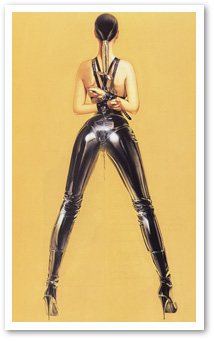 I
suppose my fascination with sexuality in general, and portrayals
of aspects of female sexuality in particular, explains my
fascination with Hajime Sorayama. His work often presents
incredibly beautiful women portrayed in positions and situations
indicating subjugation- but in almost every single instance there
is a look of power and defiance in the subject's eyes, rather than
the look of fear or submission one would expect. In her eyes also resides a challenge to the recipient of her somehow superior gaze,
and a statement that says: "you have not won." Other pieces portray women with another challenge to the (presumably
male) gaze, and that challenge is, "come near me and you will
get hurt." I think I find these portrayals compelling
because rather than the typical artist's renditions of the female
sexualized form, Sorayama pushes the boundaries of the landscapes
of human sexual interactions; exploring subtle power dynamics with
not-so-subtle imagery. And it is darned erotic as well. Of course,
my education in feminism and gender studies would demand a far
more stringent critique of the situations in which he chooses to
place the subjects of his work, and would also question my
fascination with it. Bored yet? :)
I
suppose my fascination with sexuality in general, and portrayals
of aspects of female sexuality in particular, explains my
fascination with Hajime Sorayama. His work often presents
incredibly beautiful women portrayed in positions and situations
indicating subjugation- but in almost every single instance there
is a look of power and defiance in the subject's eyes, rather than
the look of fear or submission one would expect. In her eyes also resides a challenge to the recipient of her somehow superior gaze,
and a statement that says: "you have not won." Other pieces portray women with another challenge to the (presumably
male) gaze, and that challenge is, "come near me and you will
get hurt." I think I find these portrayals compelling
because rather than the typical artist's renditions of the female
sexualized form, Sorayama pushes the boundaries of the landscapes
of human sexual interactions; exploring subtle power dynamics with
not-so-subtle imagery. And it is darned erotic as well. Of course,
my education in feminism and gender studies would demand a far
more stringent critique of the situations in which he chooses to
place the subjects of his work, and would also question my
fascination with it. Bored yet? :)
 (More
on next page)
(More
on next page)

hello | who i am | what i do | what i look like | how to meet me | links | members